

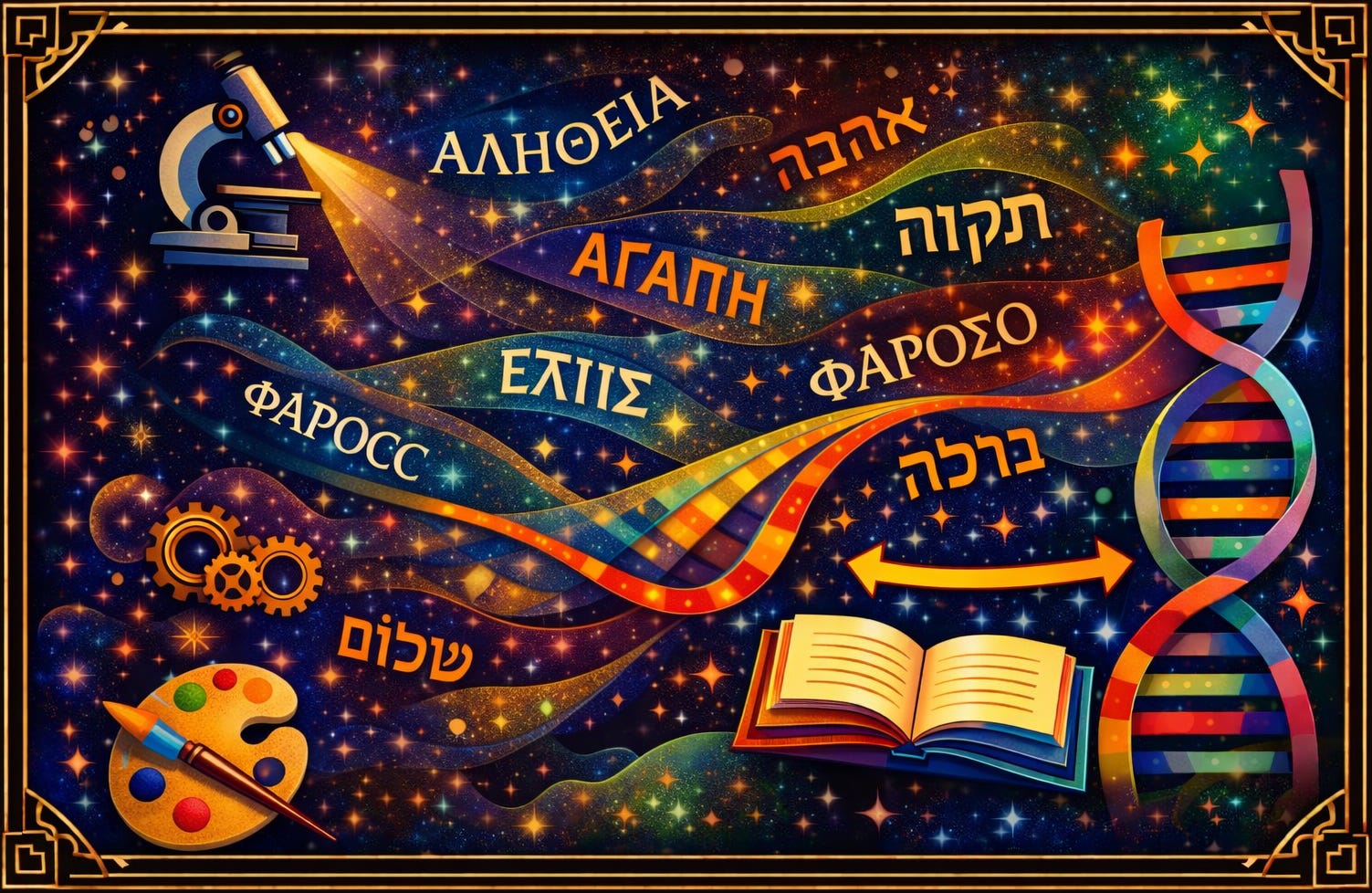
Words go in on one side, equivalent words come out on the other, and meaning passes through more or less intact. This is how translation is often imagined: a clerical task, largely mechanical, requiring care but little judgment. If that were true, translation would be easy, fast, and largely solved by machines. The fact that it is not tells us something important.
Translation is not merely technical. It requires a human presence, because there are points where multiple faithful renderings are possible and a decision still has to be made. The rules can be studied and taught, but the choice cannot be automated. And because translation rests on both structure and judgment, it is both a science and an art.
There is a scientific side to translation, and it matters. Languages have grammar. Words have ranges of meaning. Verbs carry tense, aspect, and direction. Idioms function in predictable ways inside a culture. A skilled translator studies these things carefully. They learn what a word can mean, what it cannot mean, and what it almost never means in a given context. This part of translation can be taught, tested, and improved systematically. Without it, translation collapses into guesswork.
But once the possible meanings are known, the real work begins. You still have to choose how to say it. That choice is where art enters, and where difficulty begins.
Languages do not line up neatly. A sentence that sounds casual in one language may sound formal in another. A phrase that feels emotionally neutral in one culture may feel moralizing, sarcastic, or loaded in another. Some languages tolerate repetition easily. Others hear repetition as ritual or emphasis. Some languages encode social hierarchy directly into grammar; others leave it implicit. None of this appears in a dictionary entry.
So the translator must decide: how formal should this sound? How intimate? How restrained or vivid? Should ambiguity be preserved or resolved? Should the sentence feel immediate, distant, warm, cold, sharp, or neutral? These decisions shape not only what is understood, but how it is felt, and what the listener or reader infers about intent and motive. Two translations can be equally accurate and yet land very differently in the mind.
This is where motive quietly enters, even when no one intends it to. A translator may want to help the reader, to make the message clearer, to soften something harsh, to strengthen something they believe is important, or to avoid offense. These impulses are often generous. They come from care, not manipulation. But they still recolor the text. Meaning shifts, not because the translator lies, but because they choose on the reader’s behalf.
This becomes easier to see when we think about news reporting. Journalism never reports events in a vacuum. Choices are made about which details matter, which are background, which causes are likely, and which outcomes deserve attention. To be mathematically precise, almost every sentence in news reporting should begin with “allegedly,” “according to,” or “as interpreted by.” Of course, no one writes that way, because it would be unreadable. So those qualifiers disappear, and interpretation quietly takes on the appearance of fact.
Translation works the same way. Every phrasing is a decision. Most readers never see the alternatives that were not chosen, so the translation feels transparent. “That’s just what it says.” But it isn’t that simple.
This is one reason people who care deeply about literature are often told to read major works in their original languages if they possibly can. It is not snobbery. It is an acknowledgment of loss. Even the best translation inevitably sacrifices something: rhythm, wordplay, sound patterns, cultural resonance, or emotional shading. That is why many people go to extraordinary lengths to read texts in the original. Some learn entire languages—often difficult ones—specifically to read a single author or a small body of work without mediation. This is not a rare eccentricity. It is common among people who care about meaning at a fine-grained level.
The same impulse explains why academics continue to teach Shakespeare in early modern English instead of fully modernizing him. They know modernized versions are easier to read, but they also know that something essential gets lost. Shakespeare’s language does things modern English does not do in the same way. His idioms, rhythms, and verbal inventiveness are not decorative extras. They are part of the meaning itself. Strip them out, and you still have the plot, but much of the force is gone.
There is a certain dark humor in this. Anyone aspiring to be a future Shakespearean-level genius might want to take note: if your brilliance relies heavily on dense, time-bound idioms, congratulations on your genius, but also congratulations on ensuring that future generations will suffer through having to relearn them. Then again, colloquialisms are often the easiest playground for humor. They are vivid, social, and emotionally loaded, which makes them fertile ground for comedy. So perhaps this is inevitable. If you must burden posterity, go ahead and at least entertain your contemporaries fully while you can.
All of this leads to a common misunderstanding: that simply speaking two languages means someone can translate. It does not.
Many people grow up bilingual. In many parts of the world, multiple languages live side by side for a variety of reasons, and people may speak two or more of them fluently from childhood. That does not automatically give them the ability to translate well. In fact, most bilingual people do not translate naturally at all. They switch. They move from one linguistic “state” to another, where only one language is active at a time. The other recedes into the background. Translation requires holding both languages open simultaneously, mapping meaning across them in real time, and monitoring tone, implication, and audience effect as you go. That is a distinct cognitive skill, and it is not evenly distributed.
People who can translate on the spot, inside live conversation, are doing something exceptionally demanding. This becomes visible in high-stakes political settings, where interpreters translate live between heads of state, diplomats, or military leaders. These translators do not work indefinitely. They rotate. They are replaced frequently. There are documented cases of interpreters fainting when pushed too long without relief. This is not theatrics. It is exhaustion. The brain is running at full load, continuously, with no pause and no margin for error. Decisions must be made instantly, and each one carries consequences.
This is why such events always have backup translators ready to step in. It is understood that no one can sustain that level of cognitive and moral responsibility indefinitely. Translation at that level is not casual bilingualism. It is a specialized discipline.
For all the emphasis placed on STEM fields today, it is worth saying plainly that the study of language and translation is no joke. Translating works of art, religious texts, political speech, or even everyday conversation across cultures is a serious, skilled endeavor. It carries intellectual demands, emotional strain, and ethical weight. Character matters. A translator’s restraint, honesty, humility, and sense of responsibility shape outcomes in ways that are often invisible but real.
This does not mean STEM fields lack moral stakes. Many of them carry enormous ethical weight. But translation has a unique feature: it mediates meaning itself. It decides how one human reality becomes intelligible to another. When that mediation goes wrong, misunderstanding is not just possible. It is built in.
The uncomfortable truth is that a translation can be technically correct, well-intentioned, and grammatically sound, and still be deeply misleading in effect. Not because it lies, but because it guides inference. It nudges the reader or listener toward a particular way of hearing, feeling, or concluding. This influence is especially hard to notice for people who speak only one language, or who have not spent time watching meaning shift as it crosses linguistic boundaries.
Once this becomes visible, it is hard not to notice how often mistranslation happens even when two people are speaking the same language. Words carry different weights for different people. A phrase that feels neutral to one person may feel charged to another. Tone, timing, shared history, and expectation all shape meaning as much as vocabulary does. In that sense, translation is not an edge case reserved for foreign languages. It is a constant feature of human communication, usually unnoticed, occasionally catastrophic, and almost never exact.
Translation, then, is not a problem to be solved once and for all. It is a responsibility to be carried. It requires discipline, judgment, and humility. The most honest translator is not the one who claims neutrality, but the one who knows where neutrality is impossible and works carefully to minimize distortion rather than deny it exists.
In a world saturated with translated information—videos, headlines, quotes, captions, ancient texts, modern speech—learning to hold even a small amount of awareness about how translation works is not academic. It is practical. It creates space between words and conclusions. And that space, however small, matters far more than we tend to realize.
For readers who want to see how these shifts happen in practice, there is a companion essay that lays out the most common translation pitfalls in plain language. It looks at the specific places where meaning tends to drift, even in careful, well-intentioned work: Where Translation Breaks Down Recurring pressure points where meaning narrows, hardens, or drifts.


These same pressures and hazards are especially visible in the Bible reading and translation project hosted here. Not because the text is uniquely fragile, but because it has been translated so many times, across so many centuries, with so much moral, theological, and cultural weight attached to it. The project hosted here does not treat the Bible as an exception to the realities described above, nor as a purely technical artifact to be “decoded,” but as a human text that has always been mediated through language, judgment, and restraint. The aim is not to resolve interpretation or enforce conclusions, but to make the translation process itself more visible, careful, and accountable, so that readers can encounter the text with fewer hidden filters and mhttps://www.feedthegoodhorse.com/p/where-translation-breaks-downore freedom to notice what it actually does.
The ongoing Live-Wire Bible Study can be found here.
Related essays on authority, certainty, and meaning
• Why No One in the Room Was Confused
• When Certainty Starts to Slip
• Where the Bible Refuses Absolute Authority
• When Love Becomes the Reason We Stop Looking